
What Every Iowa Homeowner Should Look For
Iowa winters are no joke. While you’re cranking up the heat to stay comfortable, something could be going wrong in your attic—and you might not even know it until spring. Attic condensation is one of the most misunderstood problems homeowners face, and catching it early can save you thousands in repairs.
While It’s Still Cold: Time for an Attic Inspection
If you haven’t been up in your attic this winter, now is the time. Whether you’re a DIY homeowner or you’d rather have a professional take a look for you, here’s what to watch for:
- Frost on the bottom of roof sheathing (plywood or OSB) and rafters
- Frost or moisture accumulation on top of the insulation
- Water droplets or damp OSB/plywood
- Mold or mildew smell when you enter the attic
- Darkened, stained, or rotting sheathing
- Icicles forming from soffits (an indirect sign of heat loss and moisture issues)
What These Signs Are Telling You: If you spot frost or moisture in your attic, it’s an indicator of either air leakage around penetrations (like recessed lights, ceiling fans, attic hatches, and bathroom exhaust fans) or insufficient insulation allowing warm air to escape. It can also point to inadequate ventilation from your roof or soffit vents.
After It Warms Up: The Damage Reveals Itself
Once temperatures rise, that frost melts—and the water has to go somewhere. Look for:
- Water staining on ceilings, especially along outside walls on the upper level
- What appears to be a roof leak (but often isn’t!)
Important: Many homeowners assume these stains mean they have a roof leak. In many cases, it’s actually condensation damage from the winter months—a completely different problem with a completely different solution.
Why Attic Condensation Happens in Winter
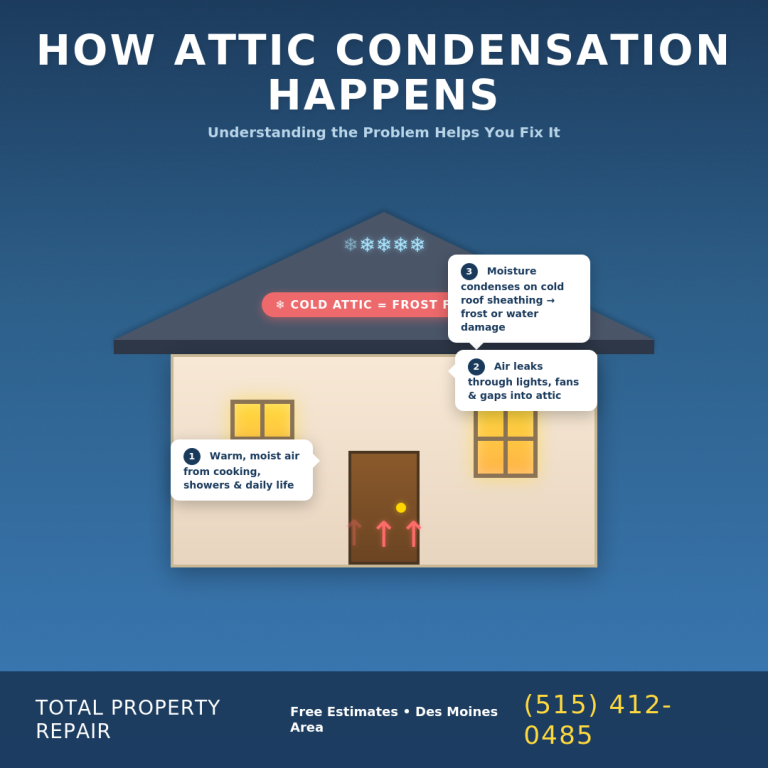
The science is straightforward: warm, moist indoor air rises and leaks into your attic through gaps and openings. When that warm air hits the cold roof sheathing, the moisture in the air condenses into water droplets or frost—just like a cold glass of water on a summer day.
Common sources of indoor moisture include:
- Bathrooms (showers, baths) and kitchens (cooking steam)
- Laundry rooms and humidifiers
- Basements and crawlspaces
- Leaky ceiling penetrations (recessed lights, ceiling fans, attic hatches)
Iowa winters make this problem worse because:
- Roof decks stay extremely cold
- Indoor air is kept much warmer for comfort
- The large temperature difference creates ideal conditions for condensation
The Problems Attic Condensation Can Cause
Don’t ignore the warning signs. Left unchecked, attic condensation can lead to:
- Mold growth – A health hazard and a major concern for home resale value
- Wood rot – Deterioration of sheathing and trusses, compromising structural integrity
- Rusted nails – Leading to premature shingle failure
- Reduced insulation performance – Wet insulation loses its R-value, making your home less energy-efficient
- Ice dams – Caused by uneven heat loss from the attic
Left untreated long-term, condensation damage can turn into a full roof redeck job—one of the most expensive repairs you can face as a homeowner.
The Real Causes (In Order of Importance)
1. Air Leaks from the House into the Attic (The Biggest Culprit)
This is the number one cause of attic condensation. Warm, moist air finds its way into the attic through:
- Bathroom fan housings
- Recessed (can) lights
- Top plates (where walls meet the attic)
- Attic access hatches and pull-down stairs
- Chimney and vent chases
Key insight: Adding more ventilation alone will NOT fix this problem. You must address the air leaks first.
2. Poor or Blocked Attic Ventilation
Even with good air sealing, your attic needs proper ventilation to allow moisture to escape. Common issues include:
- No continuous soffit intake
- Blocked or missing baffles
- Too few box vents or inadequate ridge vent
- Exhaust ventilation without adequate intake (or vice versa)
Rule of thumb: You need approximately 1 square foot of net free vent area per 300 square feet of attic floor space, balanced between 50% intake (at soffits) and 50% exhaust (at ridge or roof vents).
3. Bathroom Fans Venting Incorrectly
This is a surprisingly common problem we see in homes throughout the Des Moines area:
- Bathroom fans dumping humid air directly into the attic (big problem!)
- Flex duct sagging and holding water
- Missing dampers, allowing cold air to flow back into the home
The fix: All bathroom exhaust fans must vent completely outdoors through properly insulated and sealed ductwork.
4. Inadequate Attic Insulation
When your attic floor isn’t properly insulated, heat escapes from the living space below. This warms the roof sheathing, which melts frost—and that water can rain down onto your insulation and ceiling. Many older Iowa homes have insulation levels well below the recommended R-38 to R-60.
The Right Way to Fix Attic Condensation
Here’s the approach our team uses to solve attic condensation problems for good:
Step 1: Air Seal First (Most Important)
Before anything else, seal the air leaks. This is the most critical step and often resolves the condensation problem on its own.
- Foam or caulk around recessed light boxes
- Seal bathroom fan housings to drywall
- Seal top plates where interior walls meet the attic
- Weatherstrip and insulate the attic hatch or door
Step 2: Correct Ventilation
- Clear and clean soffit vents
- Install proper baffles to maintain airflow channels
- Add continuous soffit ventilation if possible
- Match exhaust ventilation (ridge vent is preferred for Iowa homes)
Step 3: Fix Bathroom Exhaust Fans
- Use hard pipe or properly insulated duct
- Slope duct slightly toward the exterior
- Install exterior hood with a functioning damper
Step 4: Improve Insulation
- Blow insulation to R-49 to R-60 for Iowa climate
- Important: Always complete air sealing BEFORE adding insulation
Quick Diagnostic Test
Want to assess the situation yourself? On a very cold morning, go up into your attic and look for these clues:
- Frost on nails – Indicates air leakage from the living space
- Wet sheathing near eaves – Suggests ventilation imbalance
- Mold concentrated in one area – Points to a localized air leak
The Bottom Line
More vents alone won’t fix attic condensation. The real solution is proper air sealing combined with balanced ventilation. Getting this right protects your home, saves on energy costs, and prevents expensive repairs down the road.
Need Help? We’re Here for You
If you’ve noticed any of these warning signs in your attic—or you’d simply like peace of mind with a professional inspection—Total Property Repair is here to help. We proudly serve Des Moines and surrounding communities within a 50-mile radius.
When you contact us, it helps to know:
- The approximate age of your home
- Type of roof venting you have (ridge vent, box vents, turbines, etc.)
- Whether your bathroom fans currently vent to the outdoors
We can walk you through the exact fixes your home needs or provide a detailed estimate for repairs.
Call us today at (515) 412-0485 or contact us online to schedule your free estimate.
Because Your Property Deserves the Best.